Why Are Tsavo Elephants Red? The Story Behind Kenya’s Red Giants

There is a moment in Tsavo when the landscape appears to stand up and begin walking.
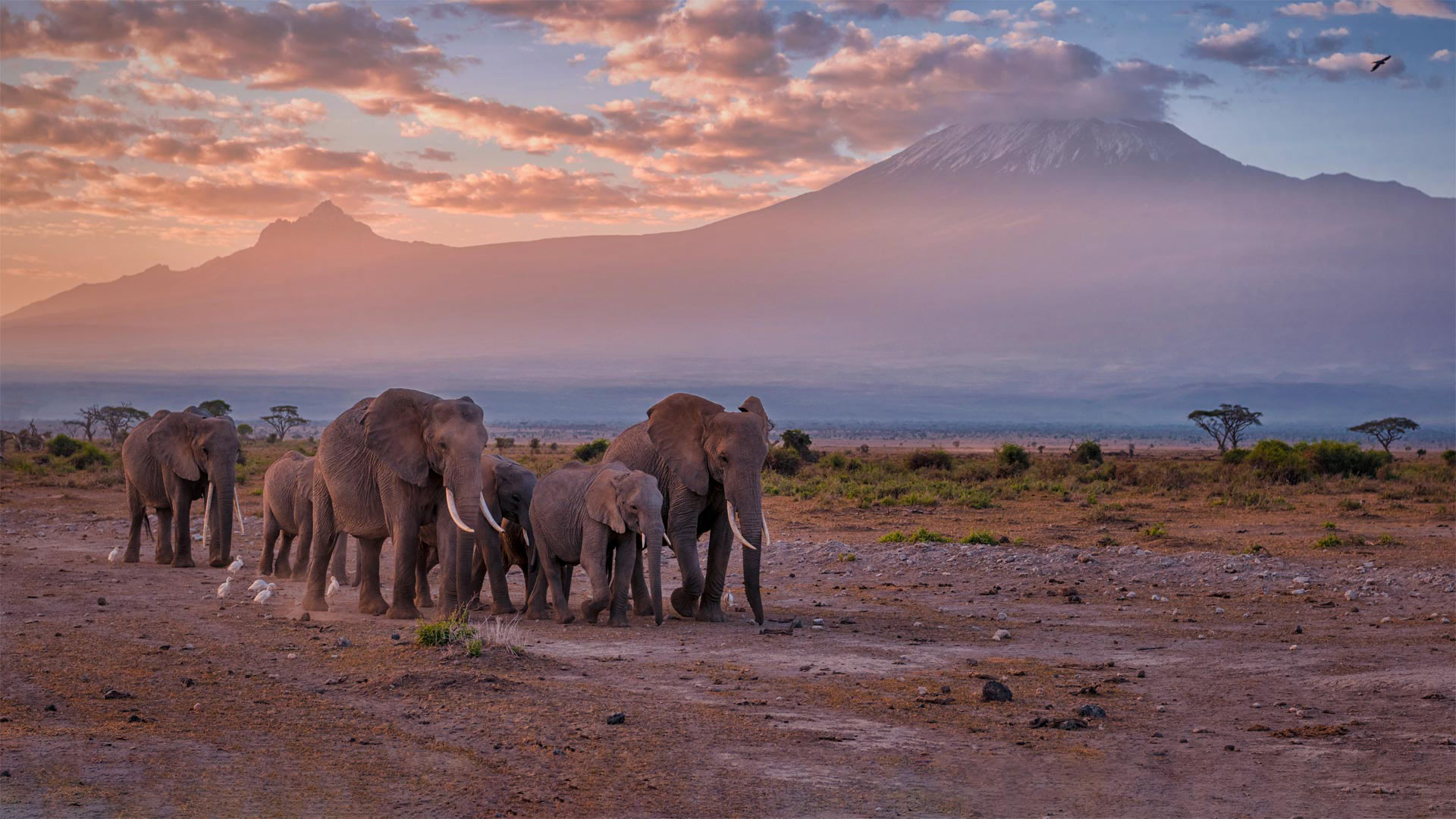
At first, all you see is red earth stretching beneath the African sun. Then a huge ear moves above the grass. A trunk rises through a cloud of dust. Another elephant appears, followed by a calf walking close to its mother.
Suddenly, the red earth has become a herd of elephants.
For many travellers experiencing a Kenya wildlife safari for the first time, this can be one of the most unforgettable sights in the country.
It also creates an obvious question: why are Tsavo elephants red during a Kenya wildlife safari tour?
The answer begins beneath their feet.
Tsavo elephants are not a different red-coloured species. They are African savanna elephants, and beneath the dust their skin is naturally grey. Their famous rusty colour comes from repeatedly bathing, wallowing and dusting themselves in Tsavo’s iron-rich red soil.
Peer-reviewed research published in Frontiers in Ecology and the Environment explains that the soils of Tsavo contain high concentrations of iron oxides. When elephants take mud or dust baths, these particles coat their skin and effectively colour the elephants red.
In other words, Tsavo does not produce red elephants.
Tsavo paints them.
Why Are Tsavo Elephants Red?
The famous red elephants of Tsavo get their colour from the iron-rich soil found across the Tsavo ecosystem.
Tsavo Trust explains that much of this soil is classified as ferralsol, a deeply weathered tropical soil containing high levels of iron oxide. Iron oxide is responsible for the strong red colour seen across parts of the Tsavo landscape.
Elephants regularly spray dust over themselves and wallow in mud. When the fine red soil settles into their wrinkled skin, their natural grey colouring becomes covered by shades of rust, ochre, orange and deep red.
The effect can be especially dramatic in Tsavo East National Park, where open landscapes and red earth create one of the most recognisable wildlife scenes in Kenya.
This is not simply a beautiful accident. Dust and mud bathing are important parts of elephant behaviour.
Why Do Elephants Throw Dust Over Themselves?
Watching an elephant throw soil across its back can look playful, particularly when young calves try to imitate older members of the herd.
However, dust bathing has important functions.
Scientific research on elephant behaviour has associated dusting and mud bathing with skin care, protection against biting insects, protection from intense sunlight and responses to high environmental temperatures.
Elephants also have relatively few sweat glands compared with humans. They therefore rely on several behavioural adaptations to deal with heat, including seeking shade, flapping their ears, bathing in water, covering themselves with mud and throwing dust over their skin.
Research on savanna elephants has observed animals seeking opportunities to wet their skin through mud bathing and swimming as temperatures increase.
So, when a Tsavo elephant lifts its trunk and sends a cloud of red earth over its body, the behaviour is doing much more than creating a beautiful photograph.
It is part of everyday elephant life.
And in Tsavo, everyday elephant life happens to come in red.
Want to See Kenya's Famous Red Elephants?
Experience Tsavo East and Tsavo West with NAMSA Prestigious Tours. We create private, budget, mid-range and luxury Kenya safari itineraries based on your travel dates, group size and preferred level of comfort.
Email: booking@namsaprestigioustours.com
Call: +254759711215 / +254 716 549 495
Are Tsavo Elephants Actually Red?
No.
Underneath the soil, they are grey African savanna elephants.
The strength of the red colour changes depending on how recently an elephant has bathed or dusted itself, the condition of the soil and weather conditions.
Fresh wet mud can produce a darker rusty appearance. Fine dry soil can create the brighter red and orange colouring commonly seen in photographs from Tsavo safaris.
This also explains why the same elephant may appear different from one day to another.
After rainfall, the contrast can be remarkable. A red-coated elephant walking through fresh green vegetation stands out beautifully against the landscape.
During the dry season, the opposite can happen. Its dusty colour can almost merge with the surrounding red earth.
Tsavo has dressed the elephant in the colour of its home.
Tsavo East National Park: The Classic Home of Kenya’s Red Elephants
For Kenya travellers hoping to see the famous red elephants, Tsavo East is usually the destination most closely associated with them.
Kenya Wildlife Service describes Tsavo East as Kenya’s largest national park and a vast semi-arid wilderness where dust-red elephants move across open plains, acacia scrub and volcanic landscapes.
Its enormous scale is part of the experience.
The Galana River cuts through the dry landscape and provides an important wildlife corridor. The Yatta Plateau forms another major feature of the park, while locations such as Mudanda Rock and Aruba Dam add variety to game drives in Kenya’s southeastern wilderness.
Because much of Tsavo East is relatively open, travellers can sometimes enjoy long views across the savannah.
An elephant herd may appear as tiny red shapes in the distance before gradually growing larger as the safari vehicle follows the road.
For photographers, this space can be as important as the wildlife itself.
Instead of seeing only an elephant, you can photograph an elephant within its environment: red soil, blue sky, acacia trees and the immense scale of Tsavo.
This is what makes a Tsavo safari different from many other Kenya safari destinations.
Tsavo West National Park: Lava, Springs and Wild Landscapes
Tsavo West tells a different story.
While Tsavo East is famous for open red plains, Tsavo West combines savannah, volcanic terrain, hills, springs and denser vegetation.
Kenya Wildlife Service identifies Mzima Springs, Shetani Lava Flow, Lake Jipe, Roaring Rocks and Poacher’s Lookout among the park’s major attractions.
Mzima Springs creates an especially striking contrast with the surrounding dry country. Clear water emerges from an underground geological system linked to the Chyulu Hills, supporting fish, birds, crocodiles, hippos and surrounding vegetation.
Elephants move through this landscape too.
Some may carry the familiar rusty colour of Tsavo soil, while others appear darker after mud bathing or walking through shaded vegetation.
For travellers planning a safari to Kenya, combining Tsavo East and Tsavo West gives two very different experiences within one ecosystem.
Tsavo East offers openness and red-earth wilderness.
Tsavo West brings volcanic scenery, water, hills and dramatic viewpoints.
Together, they create one of Kenya’s great safari routes.
Tsavo’s Red Elephants and the Science Beneath Their Feet
The story becomes even more interesting when geology is added.
Tsavo Trust explains that the region’s ferralsol soils contain high concentrations of iron oxide, which gives the earth its characteristic red colour.
As elephants repeatedly dust themselves, the iron-rich particles build up across their bodies.
Peer-reviewed ecological research describes exactly this relationship between elephants and soil. After bathing, elephants may roll in mud or spray dirt over themselves. In Tsavo, the concentration of iron oxides within the soil produces the famous red appearance.
This scientific explanation is important because it corrects a common misunderstanding.
The elephants have not evolved red skin.
There is no special “red elephant” subspecies.
It is normal African elephant skin covered by an extraordinary landscape.
That makes the animals even more fascinating because their appearance shows the physical relationship between wildlife and habitat.
The land literally becomes visible on the animal.
Where Is the Best Place to See Red Elephants in Kenya?
Tsavo East National Park is the most recognised destination for seeing them.
However, elephants range across the greater Tsavo ecosystem, including Tsavo West and surrounding wildlife areas.
The wider Tsavo Conservation Area is particularly important for elephant conservation.
Tsavo Trust says the ecosystem contains Kenya’s largest single elephant population and remains one of the world’s most important landscapes for elephants carrying exceptionally large tusks.
Some of these elephants are known as Super Tuskers, older animals whose enormous tusks can extend close to the ground.
Seeing a Super Tusker is never guaranteed, and responsible guides should never promise one.
Wildlife is wild.
That uncertainty is part of what makes a genuine Kenya safari experience so powerful.
Responsible Wildlife Viewing in Tsavo
A memorable safari should never come at the expense of the animals being observed.
Kenya Wildlife Service advises visitors to move slowly and quietly, remain inside vehicles except in designated locations, stay on established roads and give wildlife space.
KWS also advises visitors to observe wildlife from at least 20 metres away and never feed animals.
These rules are especially important around elephants.
An elephant herd may include small calves protected closely by adult females. Blocking a herd’s path, driving too close or surrounding animals with several vehicles can create unnecessary pressure.
Professional Kenya safari experts understand that the best sighting is not always the closest sighting.
Sometimes the unforgettable moment comes from stopping the vehicle, switching off the engine and allowing the herd to decide what happens next.
A matriarch may cross the road.
A calf may disappear between two adults.
An elephant may stop to dust itself only metres beyond the vehicle.
Responsible wildlife viewing in Kenya requires patience.
Conservation and the Future of Tsavo’s Elephants
Tsavo’s importance goes far beyond tourism.
Tsavo Trust works with Kenya Wildlife Service and other conservation partners on wildlife monitoring, aerial surveillance and ground protection across the Tsavo Conservation Area.
Particular attention is given to Tsavo’s remaining large-tusked elephants.
Recent Tsavo Trust reporting identifies Tsavo as one of the last major strongholds for Super Tuskers, making the ecosystem globally important for elephant conservation.
This is one reason sustainable safari Kenya practices matter.
Safari tourism can support protected areas, conservation employment and surrounding communities, but the tourism experience must respect the landscape that makes it possible.
Responsible safari companies in Kenya should therefore encourage wildlife-friendly driving, respect park regulations and avoid treating animals as if sightings can be staged on demand.
Wildlife conservation and tourism depend on each other.
Without healthy ecosystems there is no meaningful safari.
Budget, Mid-Range or Luxury Tsavo Safari?
One advantage of Tsavo is that it can be included in several travel styles.
A budget safari focuses on value while keeping the wildlife experience at the centre of the trip. Travellers may use simple lodges or camps and carefully planned road transport.
Budget safaris can be particularly suitable for travellers who care more about wildlife and time in the field than premium accommodation.
A midrange safari adds greater comfort, selected Kenya safari accommodation options, good-quality lodges or tented camps in Kenya, and more flexible transport arrangements.
For travellers seeking privacy, premium accommodation and personalised guiding, luxury safaris offer another level of comfort.
Luxury Kenya safaris may include private 4×4 vehicles, premium lodges, private guides and carefully paced itineraries.
There is no single best category.
The right option depends on the traveller.
A wildlife photographer may choose simple accommodation but spend more on a private safari vehicle.
A honeymoon couple may prefer a luxury lodge and private dining experience.
A family may prioritise comfortable rooms, shorter driving days and flexible meal times.
A solo traveller may choose group Kenya safaris to reduce transport costs.
The most important question is not whether your safari is labelled budget, mid-range or luxury.
The important question is whether the itinerary gives you enough quality time in the places you came to experience.
Not Sure Which Safari Style Fits Your Budget?
NAMSA Prestigious Tours designs budget safaris, comfortable mid-range safaris and personalised luxury Kenya safaris. Tell us your dates, number of travellers and preferred destinations, and we can suggest an itinerary that matches your budget.
Safari enquiries: booking@namsaprestigioustours.com
Which Safari Vehicle Is Best for Tsavo?
The right vehicle can make an important difference on a long safari.
Among common Kenya safari vehicle types, safari vans offer an affordable option, while 4×4 Land Cruisers provide additional ground clearance and capability for rougher conditions.
A private Land Cruiser is especially useful for photographers because travellers can control the pace of the game drive more easily.
A private safari also allows the guide to adapt the day around wildlife movement, photography interests and the group’s preferred pace.
For families, couples, photographers and small groups, private Kenya safaris can therefore offer greater flexibility.
Travellers comparing affordable Kenya safari packages should look beyond the advertised price and ask what type of vehicle is included.
How Tsavo Fits Into a Kenya Safari Itinerary
Tsavo becomes even more attractive when combined with other major Kenya safari destinations.
One excellent route connects Tsavo West with Amboseli.
Kenya Wildlife Service notes that Tsavo West can be accessed through Chyulu Gate from the Amboseli direction. This makes Amboseli National Park tours and Tsavo a natural combination for travellers who want several days focused on elephants and dramatic landscapes.
A longer Kenya safari itinerary may combine Amboseli, Tsavo West and Tsavo East before continuing towards Kenya’s Indian Ocean coast.
This produces one of the country’s classic safari-and-beach combinations.
Travellers can experience red elephants and volcanic landscapes, then continue towards Mombasa, Diani or another coastal destination.
For visitors with more time, Kenya offers many other experiences, including a Masai Mara safari, Great Migration Kenya safari, Nairobi National Park tours, Kenya cultural tours, Mount Kenya trekking tours and longer East Africa safari tours combining Kenya with neighbouring destinations.
The important principle when creating custom Kenya safari itineraries is not to add destinations simply to make the holiday look impressive.
More parks do not automatically produce a better safari.
Good itinerary design considers travelling time, wildlife interests, season, accommodation, budget and how long travellers will actually spend on game drives.
Can Tsavo Be Combined With a Kenya Beach Holiday?
Yes, and this is one of Tsavo’s advantages.
Because Tsavo lies between Nairobi and Kenya’s coast, it works particularly well for travellers who want to combine a Kenya beach holiday with safari.
A traveller can spend several days exploring Amboseli and Tsavo before continuing towards the Indian Ocean.
This creates an excellent contrast.
One morning may begin with elephants walking through red dust.
A few days later, the same traveller can be beside the ocean.
For honeymooners, families and travellers taking longer African safari holidays in Kenya, this combination can reduce unnecessary backtracking while creating a varied itinerary.
Best Time to Visit Tsavo for a Kenya Safari
Tsavo can be visited throughout the year, but conditions change with rainfall.
Drier periods generally create thinner vegetation and concentrate some wildlife around dependable water sources, which can make viewing easier.
Dry red soil can also produce dramatic elephant dust-bathing scenes.
Greener periods create a completely different atmosphere.
The vegetation becomes fresh, skies can be dramatic and birdlife becomes an important part of the safari experience.
Red elephants against bright green vegetation can be particularly beautiful for photography.
There is therefore no single perfect best time to visit Kenya safari destinations for every traveller.
Photographers, birdwatchers, families and first-time safari travellers may all prefer different conditions.
Before booking a Kenya safari, discuss your priorities with an experienced operator rather than choosing dates based only on the words “high season” or “low season.”
Practical Tsavo Safari Planning Tips
Good safari booking tips Kenya travellers should follow begin with asking exactly what is included.
Check the safari vehicle, accommodation category, meals, park entry fees, number of game drives, airport transfers and optional activities.
Ask where the accommodation is located.
A cheap lodge located far from the area you intend to explore may reduce the amount of time available for wildlife viewing.
Also consider your packing list for Kenya safari carefully.
Kenya Wildlife Service recommends useful items including drinking water, binoculars, a camera, sunscreen, insect repellent, sunglasses and first-aid supplies.
Lightweight clothing works well during the day, but early mornings can feel cooler.
Photographers should bring extra batteries, memory cards and appropriate protection for camera equipment from dust.
Travellers should also check current health precautions for Kenya travel with appropriate official health authorities before departure, especially because requirements can vary according to nationality and previous travel history.
Kenya Entry Requirements for Safari Travellers
International visitors should always confirm their entry requirements shortly before travelling because regulations can change.
Kenya currently operates an Electronic Travel Authorisation, commonly known as the eTA.
The official Kenya eTA service states that most visitors, including children, require an approved authorisation before travelling, although specified categories are exempt. Citizens of East African Community partner states are among those currently exempt for qualifying stays.
The normal processing period is generally three working days, although applications can sometimes take longer.
Travellers should therefore avoid leaving the application until the final moment.
There is also an important new requirement for travellers visiting Kenya in 2026.
From 5 October 2026, Kenya introduced mandatory Inbound Travel Health Insurance for non-Kenyan short-stay visitors, subject to specified exemptions.
The official eCitizen insurance portal says each eligible traveller requires an individual policy and lists a premium of up to USD 44 per person.
East African Community citizens, Kenyan citizens and residents, diplomats and certain other categories are exempt under the published rules.
Because these requirements can be updated, travellers should confirm the latest information through Kenya’s official government portals before departure.
This is different from ordinary comprehensive Kenya safari travel insurance, which travellers may still choose to maintain for broader risks such as trip cancellation, baggage or other travel-related events.
What to Expect on a Kenya Safari in Tsavo
A Tsavo safari is not a zoo experience.
There is no guarantee that a lion will appear beside the road at 9:00 a.m. or that an elephant will stand perfectly against the sunset.
Some hours may be quiet.
Then everything can change within seconds.
A guide may notice fresh elephant tracks.
A distant cloud of dust may begin moving.
Giraffes may suddenly focus their attention in one direction.
Then a herd of elephants appears.
This unpredictability is central to what to expect on a Kenya safari.
A good guide does not manufacture nature.
A good guide reads it.
For this reason, travellers comparing the best Kenya tour operators, recommended Kenya tour operators, trusted Kenya safari companies or top-rated Kenya safari companies should look beyond promotional claims.
Examine the company’s licence and business information. Read genuine Kenya tour reviews and Kenya safari companies reviews and ratings. Ask questions about vehicles, guides, accommodation, park fees and cancellation conditions.
The best safari company is the one that communicates clearly, creates an itinerary suitable for your needs and treats wildlife responsibly.
Why Tsavo Deserves a Place on Your Kenya Safari
Some destinations impress travellers with the number of animals they see.
Tsavo often impresses with something more difficult to describe: space.
There are long red roads stretching towards distant hills.
There are dry riverbeds, acacia trees and enormous skies.
There is volcanic rock in Tsavo West and the winding Galana River in Tsavo East.
Then, somewhere across that landscape, the earth appears to move.
An elephant emerges.
Then another.
And another.
They are not truly red.
They are grey elephants carrying the landscape on their skin.
Perhaps that is why the sight remains with travellers for so long.
Tsavo does not simply provide a place to see elephants.
It allows visitors to see how closely an animal can become connected to its environment.